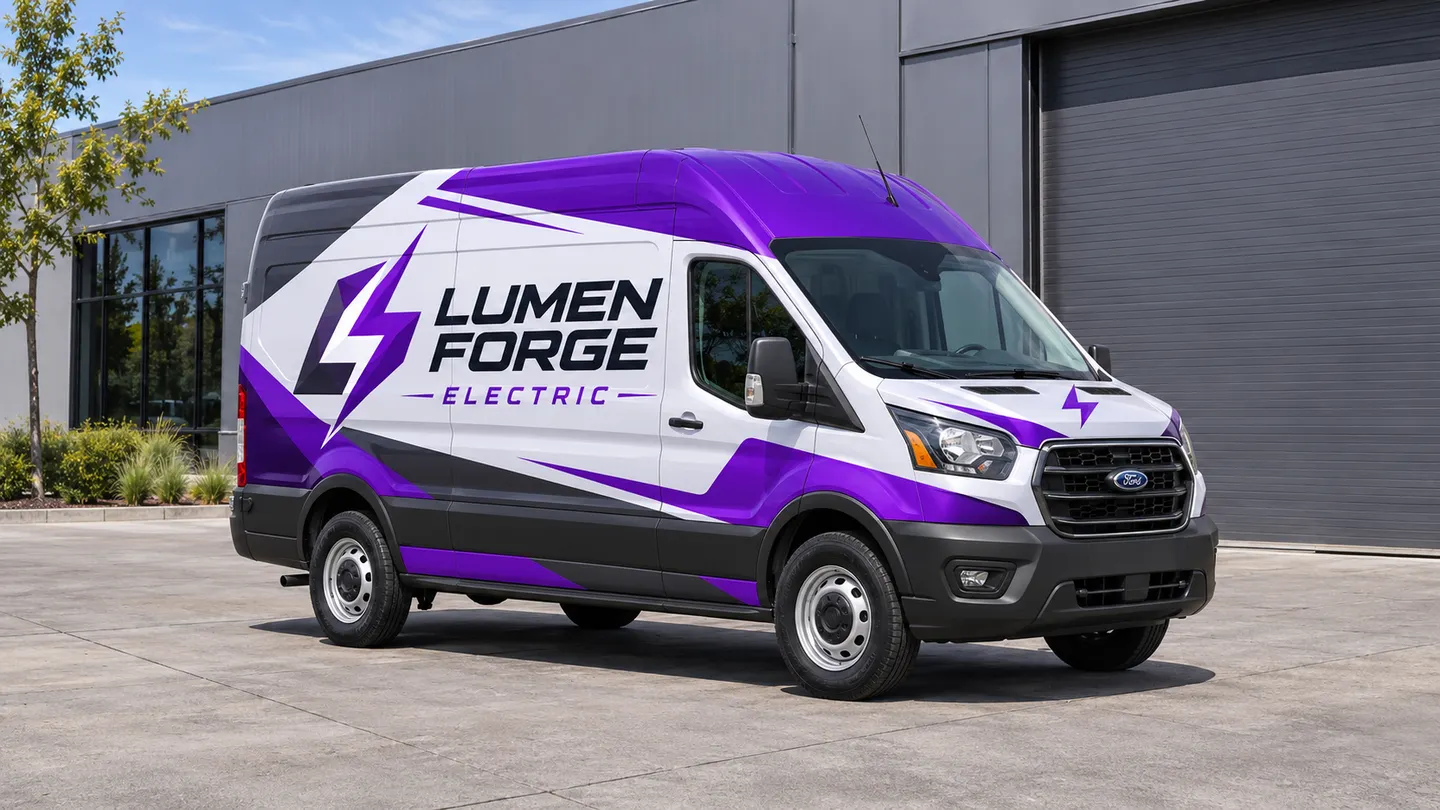
Check the object being priced
Identify the year, body configuration and number of vehicles behind the proposal. Compare those details with the actual fleet. A van description that omits roof height or wheelbase can conceal an unresolved layout assumption, even when the vehicle name sounds correct.
Match the written coverage with a marked proof or surface list. Ask whether windows, roof, bumpers, doors and accessories are included where relevant. A rendered angle can hide an unshown surface, so do not interpret a polished presentation as a complete description of the installation.
- Match every priced group to the vehicle inventory.
- Ask for surfaces missing from the written scope.
- Keep the proof revision with the proposal.
Separate production responsibilities
Read artwork development, file preparation and printing as distinct tasks. Identify who verifies wording, who supplies usable logo files and who approves the body-specific layout. A print-ready-file assumption matters if your available material is only a screenshot or a concept image.
Ask for the proposed film and protection layer, along with any relevant limitations. Use the linked manufacturer technical resources to request current documentation for those exact products. Do not treat a film brand or the word premium as a complete description of the finished construction.
- Record who supplies final wording and brand files.
- Identify adaptation and proof revisions included.
- Request product codes rather than general material labels.
Read the conditions around delivery
Look for customer preparation, removal, vehicle transport and scheduling assumptions. Confirm what happens if the delivered vehicle differs from the photos or has unexpected surface issues. A procedure for getting approval is more useful than an unresolved promise that everything will be handled.
Keep the final accepted proposal, proof and clarifications in one project record. Ask how inspection, care information and follow-up concerns will be handled at delivery. The comparer should point you back to unanswered questions; it cannot determine installation quality from checkboxes.
- Clarify preparation and removal before booking.
- Record how additional work is authorized.
- Keep the accepted documents accessible at handoff.
Keep a working record
Before you approve the next step
- Confirm the vehicle list and configuration.
- Match the proof to the written coverage.
- Identify artwork and production responsibilities.
- Request the exact material construction.
- Record exclusions and customer preparation.
- Save written answers with the accepted proposal.
Use the free planning tool to organize the details you can confirm and the questions still open.
Four questions before the next step
Is a detailed rendering enough to approve the work?
It communicates appearance, but the written scope still needs to explain surfaces, materials, preparation, responsibilities and exclusions. Keep both documents together.
Read the detailed guide: Read a commercial wrap proposal line by line
What should I do when an item is unclear?
Mark it unknown in the comparer and ask the supplier for written clarification. Do not convert unclear wording into an included item on the supplier’s behalf.
Read the detailed guide: Read a commercial wrap proposal line by line
Do matching brand names make two quotes equivalent?
No. Compare the exact products, finished construction, application, coverage and responsibilities. A shared manufacturer name does not answer those questions.
Read the detailed guide: Compare material descriptions without guessing at equivalence
Can this worksheet establish warranty eligibility?
No. It organizes the proposed documentation. Eligibility and applicable terms need confirmation against the actual products, production and application through the relevant supplier and manufacturer resources.
Read the detailed guide: Compare material descriptions without guessing at equivalence
Original technical sources
Use the linked publisher's current instructions for the exact product and vehicle. This planning guide does not replace its application, safety or warranty requirements.